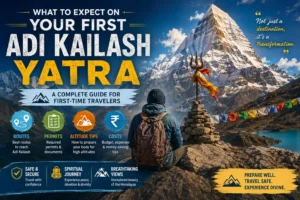
Adi Kailash Yatra 2027: A Complete Pilgrimage Guide
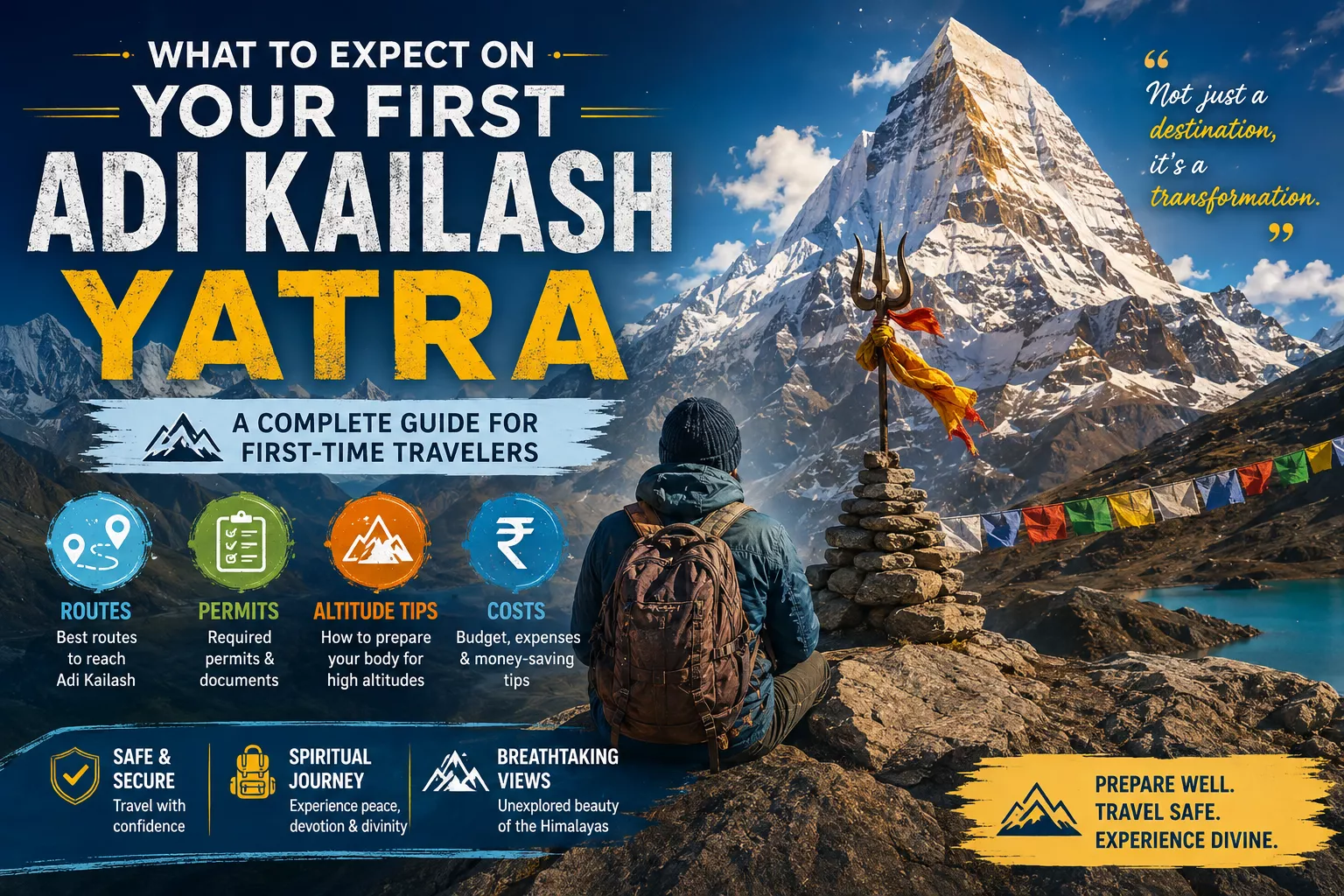
There are many sacred journeys, but the Adi Kailash Yatra offers a truly unique experience. This is more than a simple visit to a Himalayan temple. The journey reaches 5,945 metres above sea level and passes through rugged Himalayan terrain to a peak that devotees have revered for centuries as the earthly abode of Lord Shiva. The Adi Kailash Yatra in Uttarakhand, also called the Chhota Kailash Yatra, ranks among the most spiritually significant high-altitude pilgrimages that Indian devotees can undertake without travelling abroad.
If you are planning the Adi Kailash Yatra 2027, this guide covers everything you need to know, including the route, KMVN registration, cost, best time, packing list, weather conditions, emergency contacts, and other practical details that many travel guides overlook. Read the complete guide before making your booking.
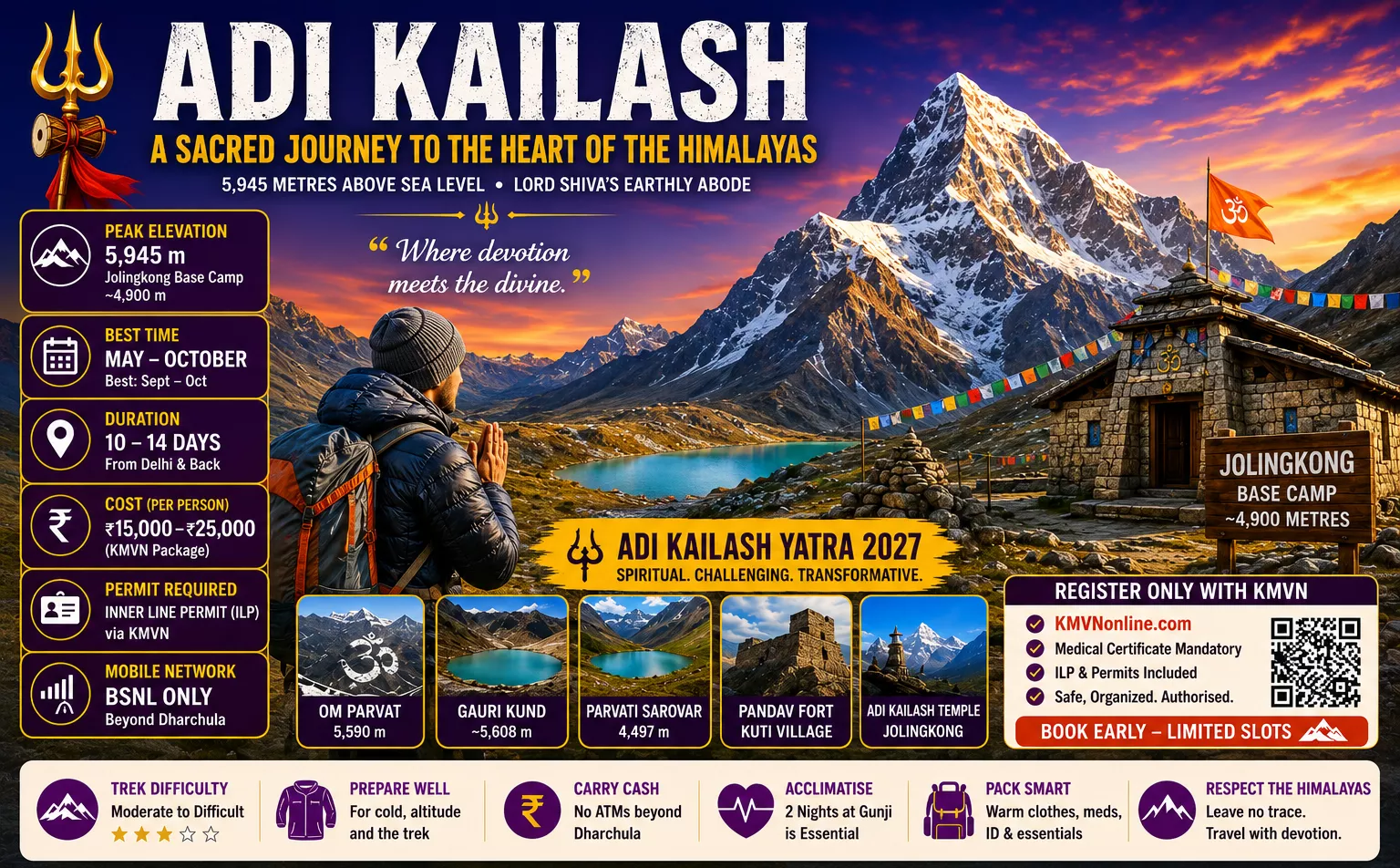
⚡ Adi Kailash Yatra Quick Facts
- Destination: Adi Kailash (Chhota Kailash), Pithoragarh, Uttarakhand
- Peak Elevation: 5,945 metres | Jolingkong Base Camp: ~4,900 metres
- Trek Difficulty: Moderate to Difficult | Duration: 10-14 days from Delhi
- Season: Mid-May to mid-October | Best Month: September-October
- Permit Required: Yes, Inner Line Permit (ILP) via KMVN | Medical Certificate: Mandatory
- Budget (KMVN Package): Rs. 15,000-25,000 | Helicopter: Rs. 25,000-45,000+ (verify with operator)
- Nearest ATM: Dharchula (no ATMs beyond) | Mobile Network: BSNL only beyond Dharchula
- Registration: KMVNonline.com | Entities: Adi Kailash, Om Parvat, Jolingkong, Gunji, Dharchula, Pithoragarh, KMVN, Uttarakhand Tourism
Historical and Mythological Significance of Adi Kailash
Earthly Abode of Lord Shiva
According to Hindu mythology, devotees regard Adi Kailash as a sacred earthly form of Lord Shiva’s divine abode. Ancient beliefs connect this Himalayan peak with Lord Shiva’s meditation and spiritual presence. The mountain also symbolizes the eternal connection between Lord Shiva and Goddess Parvati, with its stone, snow, and surrounding landscape reflecting their divine bond.
Many Hindu devotees and Shaiva traditions view Adi Kailash Darshan as spiritually similar to Mount Kailash in Tibet. The Chhota Kailash Yatra offers Indian pilgrims a way to experience this sacred Himalayan region without the international travel requirements and added logistical challenges of the Tibet route. This spiritual importance has helped the Adi Kailash Yatra gain popularity among Indian pilgrims in recent years.
The Legend of Parvati’s Devotion
One of the most cherished legends associated with Adi Kailash tells the story of Goddess Parvati’s unwavering devotion to Lord Shiva. Parvati deeply loved Shiva and wished to marry him. However, Shiva remained devoted to his intense tapasya and placed several difficult tests before her. Parvati accepted every challenge and completed each task with complete faith and determination. Impressed by her dedication and steadfast devotion, Shiva accepted her and agreed to their divine union. This sacred legend adds a powerful spiritual meaning to Adi Kailash and continues to inspire pilgrims across generations.
The Panch Kailash: Five Sacred Peaks of Lord Shiva
Adi Kailash forms part of the revered Panch Kailash, a group of five Himalayan peaks traditionally associated with Lord Shiva. These sacred mountains hold deep religious significance for devotees. Here is the complete reference:
| Kailash Peak | Location & Elevation | Key Feature |
|---|---|---|
| Kailash Mansarovar | Tibet 6,638 m |
Primary Shiva abode and the most sacred among the Kailash peaks. |
| Adi Kailash (Chhota Kailash) | Uttarakhand, India 5,945 m |
India-accessible earthly counterpart of Mount Kailash. |
| Shrikhand Mahadev | Himachal Pradesh 5,155 m |
Known for its Shiv Lingam-shaped rock formation. |
| Kinnaur Kailash | Himachal Pradesh 6,050 m |
Features a crystal-like Shiv Lingam that is visible at dawn. |
| Manimahesh Kailash | Himachal Pradesh 5,574 m |
Manimahesh Lake lies below the peak and hosts an annual religious fair. |
The Cosmic Dance: Shiva’s Tandava
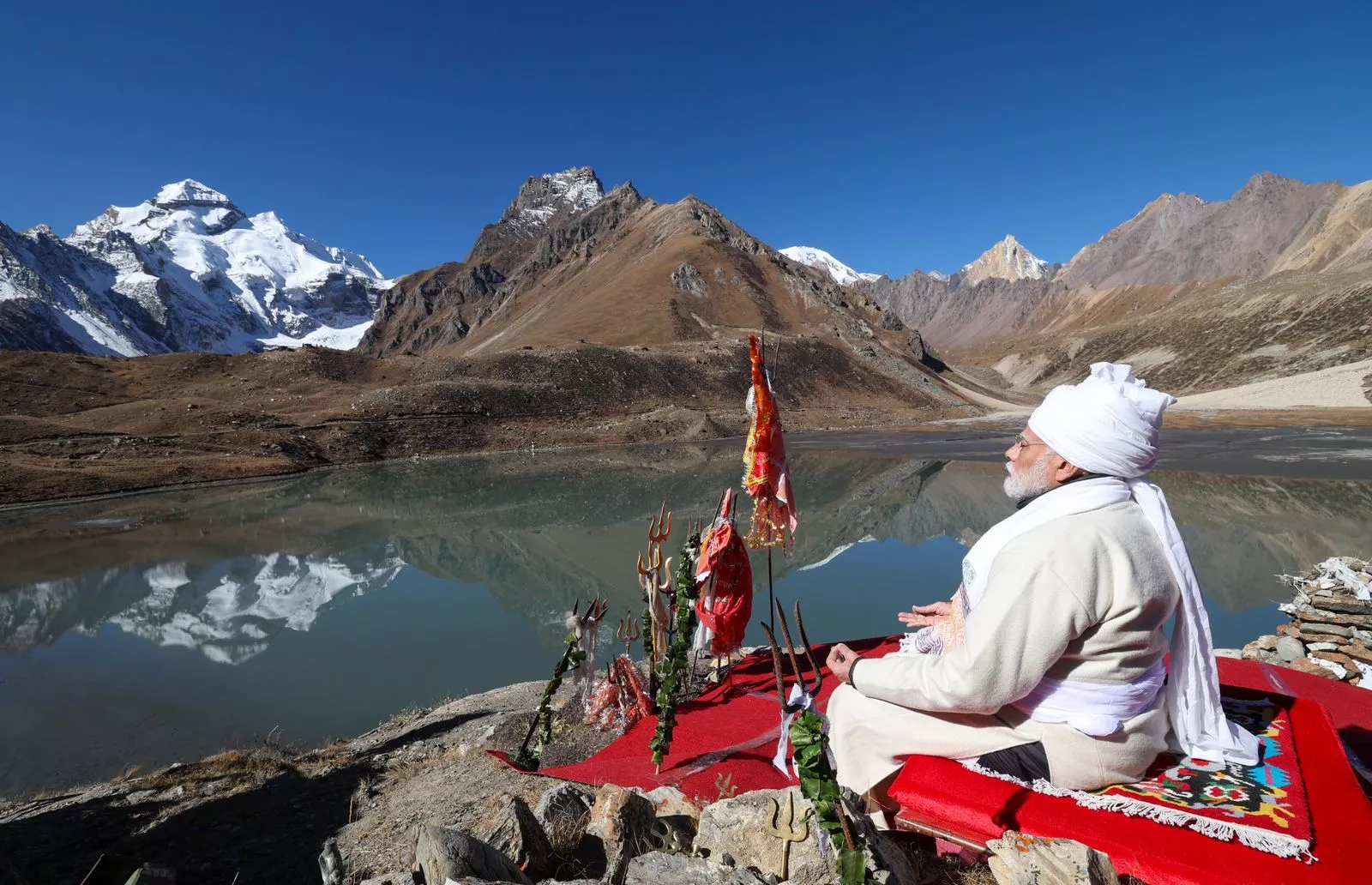
Adi Kailash also carries a sacred connection with the story of Lord Shiva performing his cosmic Tandava dance before Sage Ashtavakra. According to this legend, Shiva revealed his divine form through the powerful dance. This belief further enhances the spiritual importance of the mountain for Shaiva devotees and adds another layer to its ancient mythology.
Geographical Significance of Adi Kailash
Adi Kailash rises to 5,945 metres above sea level in Uttarakhand’s Pithoragarh district, close to the India-Tibet border. The region remains rugged, remote, and challenging to access. As pilgrims travel higher, the landscape changes from green forest valleys to alpine meadows, rocky slopes, and areas covered with permanent snow.
Pilgrims often notice that Adi Kailash can appear to change its position as they move around the mountain or as the lighting changes. During sunrise and sunset, the snow-covered peak reflects different shades of light, creating a striking sight that many devotees describe as mystical and otherworldly.
Key Geographical Facts (Elevation Reference)
| Location / Point | Elevation |
|---|---|
| Adi Kailash Peak | 5,945 metres |
| Jolingkong (base camp / campsite area) | ~4,900 metres |
| Gauri Kund sacred lake (above Jolingkong) | ~5,608 metres (higher up from base camp) |
| Om Parvat | 5,590 metres |
| Parvati Sarovar | 4,497 metres |
| Dharchula (last major town) | ~915 metres |
| Gunji village | ~3,300 metres |
Note: Jolingkong refers to the campsite and base area located at approximately 4,900 metres. Gauri Kund is a sacred glacial lake situated higher than the campsite, at around 5,608 metres. Both are separate locations within the same region. Source: General Himalayan geographic references.
Sacred Sites Along the Adi Kailash Yatra Route
Adi Kailash Temple
The Adi Kailash Temple forms the central spiritual point of the pilgrimage and is dedicated to Lord Shiva. Located near Jolingkong, it serves as the main darshan site for pilgrims. The temple is modest in size but carries a strong spiritual atmosphere, with the rugged Himalayan surroundings and the majestic Adi Kailash peak adding to its sacred appeal.
Gauri Kund, Mount Kailash
Gauri Kund is a sacred glacial lake located at approximately 5,608 metres, higher than the Jolingkong campsite. Devotees associate the lake with Goddess Parvati and believe that she regained her divine strength here after her battle with the demon Jalandhar. Pilgrims consider its waters sacred. Due to the extreme altitude of 5,608 metres, taking a dip requires excellent physical fitness and medical clearance. This altitude is considerably higher than the Jolingkong base camp at around 4,900 metres.
Om Parvat
At 5,590 metres, Om Parvat stands among the most remarkable sights of the entire yatra. Natural snow formations on the mountain create the sacred Hindu symbol OM, giving the peak its unique spiritual appeal. The formation generally appears clearest in the morning light, especially during May-June and September-October. The Gunji-Lampiya Dhura Pass Road (GLDPR) now provides a motorable viewpoint, allowing pilgrims to see Om Parvat without undertaking a complete trek. This has made the site more convenient for senior pilgrims.
Parvati Sarovar
Located around 2 kilometres from the Adi Kailash peak at an elevation of 4,497 metres, Parvati Sarovar is a peaceful alpine lake. Many devotees regard it as a miniature form of Mansarovar Lake. According to local tradition, Goddess Parvati blessed the lake, and pilgrims believe its sacred waters offer spiritual merit.
Other Sacred Sites Along the Route
- Pandav Fort (Kuti Village): Local tradition connects this site with the Pandavas, who are believed to have rested here during their exile. It adds an important Mahabharata link to the journey.
- Kunti Parvat: Named after Mata Kunti, the mother of the Pandavas, this sacred peak lies near Kuti village.
- Brahma Parvat: Visible along the Kuti-Jolingkong route, this mountain carries an association with Lord Brahma.
- Pandav Parvat: A group of five peaks traditionally linked with the five Pandava brothers.
- Parvati Mukut: A natural rock formation that resembles a crown and is associated with Goddess Parvati.
- Shiv Parvati Temple: Located near Parvati Sarovar, this sacred temple can be reached through a short trek from Jolingkong.
Adi Kailash Yatra Route: Complete Day-by-Day Itinerary 2027
The standard Adi Kailash Yatra Route begins in Delhi and passes through Tanakpur, Pithoragarh, Dharchula, and Gunji before reaching Jolingkong. Below is the typical road-based yatra itinerary:
| Day | Route / Destination | Approx Distance | Key Highlight |
|---|---|---|---|
| 1 | Delhi to Tanakpur | ~290 km | Overnight journey — train or Volvo bus. |
| 2 | Tanakpur to Pithoragarh | ~150 km | 5–7 hrs by road through mountainous terrain. |
| 3 | Pithoragarh to Dharchula | ~90 km | Last major town; suitable for acclimatisation. |
| 4 | Dharchula to Gunji | ~90 km (motorable) | Kalapani and Narayan Ashram en route. |
| 5 | Gunji to Kuti Village | ~12 km | Pandav Fort; acclimatisation day. |
| 6 | Kuti to Jolingkong (Base Camp) | ~16 km trek | Adi Kailash darshan from the base camp. |
| 7 | Jolingkong: Gauri Kund, Om Parvat, Parvati Sarovar | Short high-altitude treks | Full darshan day; Gauri Kund is located at 5,608 m. |
| 8 | Jolingkong to Gunji (return) | ~16 km | Return trek to Gunji. |
| 9 | Gunji to Dharchula / Pithoragarh | ~90–150 km | Return journey by road. |
| 10–12 | Return to Delhi | ~290 km | Yatra concludes. |
GLDPR (Gunji-Lampiya Dhura Pass Road): This motorable route has made the journey much easier for pilgrims. Om Parvat can now be seen from a dedicated roadside viewpoint without completing a trek. This change is especially helpful for senior pilgrims and travellers with limited trekking ability. Source: Uttarakhand Tourism, KMVN.
Adi Kailash Yatra 2027 Registration: Step-by-Step Process
KMVN (Kumaon Mandal Vikas Nigam), under Uttarakhand Tourism, manages the Adi Kailash Yatra 2027 Registration process. Registration is mandatory for organised groups as well as independent trekkers. Source: KMVNonline.com.
Online Registration Steps
- Visit KMVNonline.com or the official Uttarakhand Tourism website.
- Select Adi Kailash Yatra from the pilgrimage or tour package section.
- Choose your preferred travel dates and group size.
- Enter the required pilgrim details using a valid government-issued ID, such as Aadhaar or Passport.
- Submit a medical fitness certificate issued by a registered doctor.
- Pay the applicable package fee online using UPI, net banking, or a card.
- Download and print your confirmation and permit documents.
- Keep all printed documents with you throughout the journey, as checkpoints may require them.
Independent trekkers must also obtain an Inner Line Permit (ILP) for restricted border areas. ITBP checkpoints verify these permits along the route. Pilgrims without the required ILP may be stopped and asked to return. Source: ITBP (Indo-Tibet Border Police) border zone requirements.
Documents Required
- Government-issued photo ID (Aadhaar, Passport, or Voter ID)
- Medical fitness certificate from a registered MBBS doctor
- Travel insurance covering high-altitude trekking (strongly recommended)
- Passport-size photographs (carry at least 4 extra copies)
- Inner Line Permit (through KMVN or the Pithoragarh District Magistrate office)
Best Time to Visit Adi Kailash: Weather & Season Guide 2027
The Adi Kailash Yatra season generally runs from mid-May to mid-October. During the rest of the year, heavy snowfall and harsh conditions make the route unsafe and inaccessible for pilgrims.
| Month | Weather / Conditions | Crowds | Recommendation |
|---|---|---|---|
| Mid-May to June | Routes open and weather is pleasant; some snowfields may be present. | Moderate | Excellent — Om Parvat visibility is generally good. |
| July to August | Monsoon season; landslide risk on some sections. | Low | Recommended for experienced trekkers only. |
| September to mid-October | Clear skies and stable conditions; excellent peak visibility. | Moderate | Best overall period for first-time visitors. |
| November to April | Heavy snowfall; routes are generally closed. | None | Not accessible. |
Adi Kailash Weather Details by Season
May-June: Daytime temperatures in Gunji (3,300 m) usually remain around 10-18°C. Near Jolingkong at 4,900 m, nighttime temperatures can fall to 0 to -5°C. Snow may remain on some higher trails during this period.
July-August: Heavy monsoon rainfall can make trails slippery and raise the risk of landslides, especially on sections of the Kali River valley road between Dharchula and Gunji. This period is not ideal unless you have previous experience with Himalayan monsoon trekking.
September-October: Weather conditions become more stable during these months. Gunji sees daytime temperatures of around 8-15°C, while nights at Jolingkong can fall to -2 to -8°C. Clear skies during this period often offer excellent conditions for viewing Om Parvat.
Note: These figures represent general Himalayan weather patterns, and actual conditions can change each year. Check the latest weather advisories from Uttarakhand Tourism and ITBP before starting your journey.
Adi Kailash Yatra Cost per Person 2027: Complete Budget
The Adi Kailash Yatra Cost per Person 2027 varies based on your travel arrangement. You can choose a KMVN package, hire a private operator, or plan the journey independently. The following figures are approximate:
| Expense Category | Approx Range | Notes |
|---|---|---|
| KMVN Package (11–14 days) | Rs. 15,000–25,000 per person | Includes accommodation, meals, and permits. |
| Private Tour Package | Rs. 25,000–60,000 per person | Offers more comfort and generally includes a guide. |
| Transport (Delhi to Dharchula) | Rs. 2,000–6,000 | Train to Tanakpur followed by shared taxi or bus. |
| Inner Line Permit | Nominal government fee | Obtained through KMVN or the DM office in Pithoragarh. |
| Porter / Mule Charges | Rs. 800–1,500 per day | Strongly recommended for trekking sections. |
| Helicopter (when available) | Rs. 25,000–45,000+ per person | Rates vary; verify with the operator before booking. |
| Miscellaneous (food, tips, offerings) | Rs. 3,000–5,000 | Estimated additional expenses for 10–12 days. |
These figures are general estimates based on publicly available market information, and actual costs may change each year. Always request a detailed written quotation before booking. Check the latest KMVN package rates on KMVNonline.com. Helicopter prices can change frequently, so confirm the current fare directly with the operator instead of relying on older published rates.
How to Reach Adi Kailash from Delhi: Complete Route Guide
Full Route: Delhi to Jolingkong
Travel from Delhi to Tanakpur by train or road, covering around 290 km. From Tanakpur, continue to Pithoragarh, approximately 150 km away, with the mountain drive taking about 5-7 hours. Next, travel around 90 km from Pithoragarh to Dharchula. From Dharchula, continue to Gunji for another 90 km via the motorable GLDPR road. The final stretch from Gunji to Jolingkong covers around 16 km by trek. Overall, the Delhi to Gunji journey covers approximately 600-650 km and usually takes 2-3 travel days.
1.) By Train
Tanakpur (Purnagiri Railway Station) serves as the nearest railway station. Trains connect Tanakpur with Delhi, Lucknow, and several other cities in North India. From Tanakpur, you can take shared taxis or KMOU buses to Pithoragarh. The road journey generally takes 5-7 hours, depending on road and weather conditions. Avoid planning this drive as a 3-4 hour trip, as mountain roads often take longer.
2.) By Air
Pantnagar Airport (PGH) is the nearest airport with regular connectivity and lies approximately 250 km from Pithoragarh. From Pantnagar, a private taxi takes around 5-6 hours to reach Pithoragarh. Jolly Grant Airport in Dehradun also serves travellers, but this option involves considerably more road travel.
3.) By Road
Pithoragarh connects to Dharchula through a well-used mountain road. The Kali River valley road continues from Dharchula towards Gunji. Improved access through the GLDPR has made travel around the Gunji-Adi Kailash region easier and reduced the need for trekking on several sections of the route.
Get more details in depth: https://www.triptochardham.in/how-to-reach-adi-kailash
Adi Kailash Weather, Mobile Network & Oxygen Levels: What to Expect
Mobile Network Availability
BSNL is generally the only mobile network available beyond Dharchula on this route. Jio, Airtel, and Vi (Vodafone-Idea) usually do not work beyond Dharchula. At Gunji and higher locations, even BSNL connectivity can remain intermittent. Download maps, important documents, and emergency contacts before leaving Dharchula. Some operators may also provide satellite phone facilities for emergency situations.
Oxygen Levels at High Altitude
At Jolingkong (4,900 m), oxygen availability is approximately 55-58% of sea-level levels. At Gauri Kund (5,608 m), it falls to around 50%. These high elevations require proper acclimatisation and gradual ascent. Sudden physical exertion can increase the risk of Acute Mountain Sickness (AMS). Take symptoms such as headaches or dizziness seriously and avoid pushing your body beyond its limits.
Road Conditions
The Dharchula-Gunji road runs through the Kali River valley and includes narrow mountain stretches. During the monsoon months of July and August, landslides can affect the road and cause temporary closures. The GLDPR section has improved access, but travellers still encounter challenging high-altitude mountain roads. Drive carefully and check ITBP and local authority advisories for road conditions before starting each day’s journey.
Accommodation Along the Adi Kailash Yatra Route
Accommodation options along the route include KMVN rest houses and basic village guesthouses. Facilities become very limited at higher elevations, so arrange and confirm your stay well in advance.
| Location | Accommodation Available | Booking |
|---|---|---|
| Dharchula (~915 m) | Hotels, guesthouses, and KMVN rest house. | Advance booking recommended. |
| Gunji (~3,300 m) | KMVN Tourist Rest House (primary option). | Book through KMVNOnline.com. |
| Kuti Village | Basic guesthouses and tents. | Very limited — confirm availability before arriving. |
| Jolingkong (~4,900 m) | Basic accommodation and camping. | Usually included in the KMVN package. |
During the peak season, especially June and September-October, KMVN rest houses can fill up quickly. Book your accommodation along with your permits to secure a place to stay. Do not depend on walk-in availability at Gunji or Jolingkong.
Adi Kailash Yatra Packing List: What to Carry
Clothing and Gear
- Thermal inners (top and bottom): Wear them at night, especially above Dharchula.
- Fleece mid-layer jacket + windproof and waterproof outer shell
- Down jacket or sleeping bag: Choose one rated to at least -10°C.
- Trekking boots: Carry waterproof boots with ankle support and break them in before the trip.
- 3-4 pairs of woollen socks, warm gloves, balaclava, and warm hat
- UV-protection sunglasses: High-altitude sunlight can be very intense.
- Trekking poles: Strongly recommended, particularly during descents.
Medical / Health Checklist
- Diamox (acetazolamide): Carry it for altitude sickness only after consulting your doctor.
- Pulse oximeter: Check blood oxygen levels regularly above 3,500 m.
- First aid kit: Include bandages, antiseptic wipes, blister patches, and pain relief medicine.
- Water purification tablets or UV pen: Treat stream or spring water before drinking.
- Sunscreen SPF 50+ and SPF lip balm: Protect exposed skin from strong high-altitude UV rays.
- ORS sachets / electrolyte powder: Help maintain hydration at high altitude.
- Personal prescription medicines: Carry sufficient supplies along with copies of prescriptions.
- Medical fitness certificate: Keep the original document with you throughout the yatra.
Documents and Essentials
- Original government ID + at least 3 photocopies
- Inner Line Permit and KMVN booking documents: Carry printed copies as required.
- Cash (Rs. 10,000-15,000 minimum beyond Dharchula): There are no ATMs beyond this point.
- Power banks (2 recommended): Charging facilities can be unreliable above Gunji.
- Offline maps: Download Maps.me or Google Maps for offline navigation.
- Emergency contact list: Save all important numbers offline before starting the journey.
Emergency Contacts: Adi Kailash Yatra Route
Save these important contacts offline before leaving Dharchula:
| Authority | Purpose | Contact |
|---|---|---|
| KMVN Office Pithoragarh | Registration, permits, and accommodation-related issues. | Visit KMVNOnline.com for the current contact number. |
| District Administration Pithoragarh | Emergency permits and ILP-related queries. | Via the official Pithoragarh district website. |
| ITBP (Border Zone) | Border checkpoint-related queries. | Maintain contact through the KMVN officer. |
| Uttarakhand Tourism | General yatra-related queries. | www.uttarakhandtourism.gov.in |
| State Disaster Management | Landslide and weather emergencies in Uttarakhand. | 1070 (Uttarakhand SDMA helpline) |
| National Emergency | Ambulance, Police, and Fire emergencies. | 112 |
Important: KMVN and district office contact numbers can change from time to time. Always check the latest contact details on KMVNonline.com or the official Uttarakhand Tourism website before starting your trip.
What Recent Pilgrims Report: Ground-Level Insights?
To provide practical, experience-based information, the following points reflect general observations shared in pilgrim accounts and travel reports about the Adi Kailash Yatra:
- The Kuti to Jolingkong stretch of around 16 km, covering elevations from 4,000 to 4,900 m, is often considered the most demanding part of the journey. Even pilgrims with previous Char Dham trekking experience can find this section challenging.
- Gunji acclimatisation plays an important role. Pilgrims who skip a rest day often report headaches and lower energy at Jolingkong. Spending two nights at Gunji can make the higher-altitude journey more comfortable.
- The natural OM formation on Om Parvat does not appear clearly in every weather condition. Pilgrims often recommend clear early mornings in October for better viewing opportunities.
- Food at Jolingkong remains basic, with simple cooked meals available at KMVN rest houses. Experienced trekkers often carry dry snacks and extra rations for additional nutrition when needed.
- The Jolingkong experience stands out for its silence, mountain scenery, and remote spiritual atmosphere. Many pilgrims value its peaceful surroundings and the raw character of the sacred Himalayan landscape.
- Mobile connectivity becomes extremely limited beyond Dharchula, apart from intermittent BSNL coverage. Pilgrims commonly recommend sharing their day-by-day itinerary with family before entering areas with little or no network.
Adi Kailash Yatra for Senior Citizens: Can You Do It?
Yes, senior citizens can undertake the Adi Kailash Yatra with proper planning, medical clearance, and support from a reliable operator. The motorable GLDPR road has also improved access for older pilgrims.
- Medical clearance: A cardiologist’s check-up is strongly recommended for pilgrims above 60 and is mandatory for those above 65.
- Choose an organised group: Travel with KMVN or a trusted private operator instead of planning the journey independently.
- Allow time for acclimatisation: Spend 2 nights at Gunji (3,300 m) before continuing towards Kuti and Jolingkong.
- Use mules and porters: Mules and porters are available on trekking sections and can reduce physical strain.
- Consider a helicopter package: Where available, helicopter services can make the journey considerably easier.
- Carry a pulse oximeter: Check oxygen levels regularly and follow medical advice if readings fall below 85%.
The GLDPR road has made Om Parvat Darshan more accessible and allows senior pilgrims to travel closer to the Jolingkong area by road. However, the trek to Jolingkong remains the main physical challenge. With honest preparation, gradual acclimatisation, and proper support, senior pilgrims can make the journey more manageable.
Common Mistakes to Avoid on Adi Kailash Yatra
- Skipping acclimatisation: Gaining altitude too quickly can create serious health risks. Spend 2 nights at Gunji before moving higher.
- Carrying too little cash: ATMs are not available beyond Dharchula. Keep at least Rs. 10,000-15,000 in cash before leaving Dharchula.
- Ignoring ITBP and local weather warnings: Himalayan conditions can change quickly. Follow official advice instead of sticking to a fixed schedule.
- Underestimating the cold: Night temperatures around Jolingkong can fall to -5 to -8°C during September-October. First-time visitors often underestimate how cold it can get.
- Travelling without a local guide on the Kuti-Jolingkong route: Poor visibility or light snowfall can make trails difficult to follow. A local guide provides important support.
- Failing to pre-book KMVN accommodation: Gunji and Jolingkong have limited stay options, and walk-in rooms are not guaranteed, particularly in June and September.
- Overlooking medical risks: Avoid the journey with unmanaged heart problems, uncontrolled hypertension, severe asthma, or other conditions that may worsen at high altitude.
- Relying on one SIM network: BSNL provides the only regular mobile coverage beyond Dharchula in many sections. Having at least one BSNL SIM in the group is advisable.
Pro Tips for Adi Kailash Yatra 2027
- Begin fitness training 4-6 weeks early: Walk 5-10 km daily, climb stairs, and include basic cardio workouts. Good fitness matters on the Kuti-Jolingkong stretch.
- Book KMVN packages early: Try to reserve May-June slots by February or March, as peak-season availability can fill quickly.
- Choose September: It offers post-monsoon clarity, more stable weather, and generally better conditions for Om Parvat viewing.
- Prepare for limited connectivity: Download important information and communication options before leaving Dharchula, as regular mobile service becomes unreliable.
- Carry a small notebook and pen: These can prove useful at checkpoints when using digital devices becomes difficult.
- Plan your Om Parvat viewpoint visit in the morning: The natural OM formation is often easier to see between 7-9 AM when morning light improves visibility.
- Carry high-energy snacks: Dry fruits such as almonds, walnuts, and raisins, along with energy bars and electrolyte sachets, provide useful extra nutrition beyond Gunji.
- Consider a helicopter package for elderly family members: Where available, helicopter services can reduce physical strain and make the journey more manageable for senior travellers.
Adi Kailash Helicopter Booking: Is It Worth It?
The helicopter option for the Adi Kailash Yatra has become increasingly popular, especially among senior pilgrims and families. Services generally operate from Pithoragarh or Gunji through KMVN-empanelled private operators.
- Helicopter packages: Approximately Rs. 25,000-45,000+ per person. Rates can change frequently, so confirm the latest price with the operator before booking.
- Limited seats: Availability is very limited. Book 3-4 months ahead for peak periods such as June and September-October.
- Weather dependence: Flights can face cancellations or delays due to changing mountain weather. Keep a road travel backup plan.
- Acclimatisation: Most helicopter packages allow acclimatisation time at Gunji before travelling to higher elevations.
- Best for: Senior citizens, families with children, pilgrims with limited physical ability, and travellers with limited time.
For physically fit pilgrims with enough time, the road and trekking route can offer a more complete experience. The gradual journey through Kumaon, changing Himalayan scenery, and the Kali River valley form an important part of the Adi Kailash Yatra and its spiritual appeal.
Adi Kailash vs Kailash Mansarovar – Complete Comparison
| Factor | Adi Kailash | Kailash Mansarovar |
|---|---|---|
| Location | Pithoragarh, Uttarakhand, India | Tibet, China |
| Visa Requirement | None — open to all Indian citizens. | China visa + Government of India quota. |
| Season | Mid-May to mid-October | June to September |
| Peak Elevation | 5,945 m | 6,638 m |
| Darshan Point Elevation | ~4,900 m (Jolingkong base camp) | ~5,600 m (Dolma La Pass) |
| Approx Cost | Rs. 15,000–60,000 | Rs. 1,50,000–2,50,000+ |
| Physical Demand | Moderate to high | Very high |
| Spiritual Status | Considered spiritually comparable by many Shaiva traditions. | Primary Shiva abode — highest spiritual merit. |
For most Indian pilgrims, the Adi Kailash Trek Uttarakhand offers a practical and spiritually meaningful pilgrimage without the international travel requirements, government quota system, and higher expenses associated with the Tibet route. Pilgrims who have completed the journey often describe the spiritual experience at Jolingkong, especially during dawn, as deeply fulfilling in its own right.
Frequently Asked Questions
1. What is Adi Kailash Yatra and why is it significant?
The Adi Kailash Yatra is a high-altitude pilgrimage to the 5,945-metre Adi Kailash peak in Pithoragarh district, Uttarakhand. Also known as Chhota Kailash or Baba Kailash, it forms part of the revered Panch Kailash and holds deep importance for Lord Shiva devotees. The journey generally takes 10-14 days from Delhi and back through Dharchula, Gunji, and Jolingkong.
2. How to reach Adi Kailash from Delhi: what is the route?
Travel from Delhi to Tanakpur by train or bus, covering around 290 km. Continue to Pithoragarh by road for approximately 150 km, then travel around 90 km to Dharchula. From Dharchula, the route continues about 90 km to Gunji through the GLDPR motorable road. The final Gunji to Jolingkong section covers around 16 km by trek. The Delhi to Gunji distance is roughly 600-650 km and usually takes 2-3 travel days.
3. What is the Adi Kailash Yatra cost per person in 2027?
KMVN packages generally cost around Rs. 15,000-25,000 per person, while private packages may range from Rs. 25,000-60,000. Helicopter options can cost Rs. 25,000-45,000+ per person. Delhi transport may add Rs. 2,000-6,000, while miscellaneous expenses can reach Rs. 3,000-5,000. Overall, plan for approximately Rs. 25,000-75,000+, depending on your travel style. Always confirm current KMVN rates before booking.
4. What is the best time to visit Adi Kailash for first-timers?
September to mid-October is generally considered the best period for first-time visitors. Post-monsoon weather offers clearer skies, stable conditions, and better Om Parvat visibility. May-June also provides good travel conditions. Avoid July-August unless you have previous experience trekking in the Himalayan monsoon.
5. How to complete Adi Kailash Yatra registration 2027?
Visit KMVNonline.com, select the Adi Kailash Yatra package, enter your details with a valid government ID, submit your medical fitness certificate, complete the online payment, and print your confirmation documents. KMVN packages generally include the required Inner Line Permit. Booking by February-March is advisable for May-June slots because availability can fill quickly.
6. Is Adi Kailash Yatra difficult? How fit do I need to be?
The Adi Kailash Yatra involves moderate to difficult trekking. The Kuti to Jolingkong stretch, covering around 16 km at elevations between 4,000 and 4,900 metres, presents the biggest physical challenge. You should be comfortable walking 10-12 km in a day while carrying a light day pack. Start fitness preparation 4-6 weeks before the journey with regular 5-10 km walks.
7. Can senior citizens do the Adi Kailash Yatra?
Yes, senior citizens can undertake the journey with proper medical clearance and preparation. The GLDPR road allows easier access to the Om Parvat viewpoint and Gunji. A cardiologist’s clearance is recommended for travellers above 60. Spend 2 nights at Gunji for acclimatisation and consider mules or porters for trekking sections. A helicopter package can be a practical choice for pilgrims with significant mobility limitations.
8. What is the difference between Adi Kailash and Kailash Mansarovar?
Kailash Mansarovar lies in Tibet and involves international travel requirements, including a China visa and the applicable Government of India process. The trip can cost around Rs. 1,50,000-2,50,000+. Adi Kailash lies in Uttarakhand, India, so Indian pilgrims do not need foreign travel. Costs are generally lower, around Rs. 15,000-60,000 depending on the package. Many Shaiva traditions consider both destinations spiritually significant.
9. Is Inner Line Permit required for Adi Kailash Yatra?
Yes. Parts of the Adi Kailash Yatra Route pass through restricted border areas near the India-Tibet border. The required Inner Line Permit (ILP) is checked at ITBP checkpoints. KMVN packages generally arrange the ILP as part of the registration process. Independent travellers can obtain the permit through the applicable District Magistrate office in Pithoragarh or KMVN.
10. What documents are needed for Adi Kailash Yatra?
Carry a valid government-issued photo ID such as Aadhaar, Passport, or Voter ID, along with a medical fitness certificate from a registered MBBS doctor. You also need the Inner Line Permit, KMVN booking confirmation, and passport-size photographs. Keep the original documents and at least 3 photocopies with you throughout the yatra.
11. What is the Adi Kailash weather in September?
September generally offers favourable weather for the journey. Daytime temperatures at Gunji (3,300 m) remain around 8-15°C, while nighttime temperatures at Jolingkong (4,900 m) can fall to -2 to -8°C. Skies are often clear, providing good visibility, although light frost can occur at higher elevations.
12. Is mobile network available on Adi Kailash route?
Mobile connectivity becomes very limited beyond Dharchula. BSNL is generally the only network with coverage, while Jio, Airtel, and Vi may not work reliably. BSNL signals can also become intermittent around Gunji and higher areas. Download offline maps, documents, and emergency contacts before leaving Dharchula, and inform family members about your itinerary.
13. Are there ATMs on the Adi Kailash Yatra route?
ATMs are available in Dharchula but generally not beyond it. Carry at least Rs. 10,000-15,000 in cash before continuing towards Gunji and higher areas. UPI and card payments may not work reliably in remote villages and camps, making sufficient cash an important part of your preparation.
14. What altitude sickness risks exist on Adi Kailash Yatra?
The risk of Acute Mountain Sickness (AMS) increases significantly above 3,500 metres. Jolingkong stands at around 4,900 m, while Gauri Kund reaches approximately 5,608 m. Common symptoms include headache, nausea, dizziness, and fatigue. Ascend gradually, allow 2 nights for acclimatisation at Gunji, stay hydrated, and use medicines such as Diamox only as prescribed by your doctor. Seek medical help and descend if serious symptoms develop.
15. How long does the Adi Kailash Yatra take?
A standard Adi Kailash Yatra generally takes 10-14 days from Delhi and back, including travel time. Adding Om Parvat Darshan may require another 1-2 days. Helicopter packages can reduce the on-site journey to around 5-7 days, while many KMVN packages follow an 11-14 day itinerary.
16. Can Adi Kailash Yatra be done without a tour operator?
Independent travel is possible but requires considerably more planning. You need to arrange the ILP, accommodation, local guide, and porters yourself. First-time visitors should consider an organised KMVN or private operator package because managing border-zone logistics and checkpoint requirements independently can be challenging.
17. What food is available on Adi Kailash route?
KMVN packages generally provide meals at their rest houses. Dharchula has restaurants offering regular meals, while the KMVN canteen at Gunji provides basic food. Beyond Gunji, including Kuti and Jolingkong, food choices become very limited. Carry dry fruits, energy bars, instant soups, biscuits, and other dry rations for the Kuti-Jolingkong section.
18. Is Adi Kailash Yatra by road possible for the full route?
No, the entire route is not motorable. The journey from Delhi to Gunji can be completed by road, while the approximately 16 km Gunji to Jolingkong section still requires trekking. However, the GLDPR has made the Om Parvat viewpoint accessible by road from Gunji, allowing pilgrims to enjoy Om Parvat Darshan without undertaking the complete trek.
19. What is Gunji village and why is it important for Adi Kailash Yatra?
Gunji is a village located at approximately 3,300 metres in Pithoragarh district, Uttarakhand. It serves as an important checkpoint and KMVN rest location before the higher-altitude section of the yatra. Spending 2 nights here helps pilgrims acclimatise before continuing towards Kuti and Jolingkong. Gunji also marks an important transition between the road journey and the higher trekking route.
20. What is the significance of Gauri Kund on the Adi Kailash Yatra?
Gauri Kund is a sacred glacial lake situated at approximately 5,608 metres above the Jolingkong base camp at around 4,900 m. Devotees associate the lake with Goddess Parvati and believe she regained her divine strength here after battling the demon Jalandhar. Pilgrims consider its waters sacred, but the extreme altitude makes the area physically demanding and requires careful preparation.
Conclusion
The Adi Kailash Yatra combines spiritual significance with the challenge of travelling through the remote Himalayas. Standing near the Jolingkong base camp at almost 5,000 metres, with Adi Kailash rising above and the vast Himalayan silence surrounding you, creates an experience unlike most pilgrimages in India.
Whether you visit as a Lord Shiva devotee, an experienced trekker, or a traveller seeking a genuine Himalayan journey without the complexities of the Tibet route, Baba Kailash offers a memorable pilgrimage. Prepare your fitness well, complete your KMVN registration early, carry enough cash from Dharchula, and allow sufficient time for acclimatisation at Gunji.
The Adi Kailash Yatra becomes safer and more rewarding when you respect the altitude, prepare properly, and follow local instructions throughout the journey.